The Financial Basics Most People Were Never Actually Taught
Have you ever found yourself thinking:
“I wish someone had taught me this when I was younger.”
If so, you’re not alone.
(more…)
Have you ever found yourself thinking:
“I wish someone had taught me this when I was younger.”
If so, you’re not alone.
(more…)
When people think about financial planning, they often picture a fairly straightforward situation.
A steady paycheque. A mortgage. Monthly bills. Retirement savings.
For many farm families, life doesn’t look like that. Farming is more than a career. It’s a business, a lifestyle, a family legacy, and often the result of generations of hard work.
That’s why financial planning for farm families is different.
(more…)
Recently, my partner and I started watching The Madison with Kurt Russell.
In the first episode, there’s a story that really stuck with me.
He talks about taking his family to an all-inclusive resort and noticing that most of the people there were about twenty years older than they were. The point wasn’t about age itself. It was about something much deeper.
(more…)
By the time June arrives, the year often starts to feel a little more real financially.
The excitement and motivation that comes with January goals has settled. Markets have moved. Life may have shifted. And for many people, the first half of the year has gone differently than expected — sometimes in good ways, sometimes not.
That’s why June can be an ideal time to pause and reassess your portfolio and overall financial plan.
Not from a place of panic or urgency.
But from a place of clarity.
At YourStyle Financial, portfolio reviews are less about reacting to headlines and more about making sure your plan still reflects what’s important to you.
What Portfolio Rebalancing Actually Means
Portfolio rebalancing sounds technical, but the concept is relatively simple.
Over time, different investments grow at different rates. As markets move, your portfolio can slowly drift away from the original balance and risk level you intended.
For example:
Rebalancing is the process of reviewing and adjusting those allocations to bring things back in line with your long-term goals and comfort level.
It’s not about trying to predict markets.
It’s about maintaining alignment.
Why June Is a Natural Time to Review Things
Mid-year reviews can be valuable because they create space to reassess before the year moves too far ahead.
By June, people often have a clearer picture of:
Sometimes the review confirms things are on track. Other times, it reveals opportunities to simplify, adjust, or improve.
Either outcome is helpful.
Financial planning works best when it’s ongoing and adaptable — not something revisited only when markets become stressful.
Reassessing More Than Just Investments
A portfolio review is also an opportunity to step back and ask broader questions.
Good financial planning looks beyond performance numbers.
It considers how your finances connect to your lifestyle, your priorities, and your sense of stability moving forward.
Avoiding Emotional Decision-Making
One of the challenges investors face is the temptation to react emotionally when markets move.
That’s understandable. Headlines are designed to create urgency and uncertainty.
But long-term financial planning is rarely improved by short-term reactions.
A thoughtful reassessment creates space to:
For many people, that perspective is far more valuable than trying to constantly “outguess” the market.
Planning That Fits Your Comfort Level
Not everyone approaches investing the same way.
Some people want detailed conversations and active involvement. Others prefer a quieter, more simplified approach.
There’s no right or wrong way to engage with financial planning.
The important thing is that your portfolio and overall plan reflect:
At YourStyle Financial, the process is designed to feel approachable and collaborative — not overwhelming.
What’s Important to You?
At the centre of every portfolio review is a simple question:
What’s important to you?
Because financial planning isn’t just about investment returns. It’s about supporting the life you’re building and making sure your plan continues to reflect what matters most.
June can be a good reminder that financial planning doesn’t need to happen only during major life events or market uncertainty.
Sometimes it’s simply about taking the time to reassess thoughtfully.
If it’s been a while since you reviewed your portfolio or financial plan, this may be a good opportunity to check in and make sure things still feel aligned with where you’re headed.
If you’d like to have a conversation about your portfolio, your goals, or where things are headed, you’re always welcome to reach out.
— Sean
There’s a phrase I hear often lately:
“I want to save… but everything already feels expensive.”
And honestly, that feeling is understandable.
Between groceries, housing costs, interest rates, childcare, transportation, and everyday life, many people feel stretched thin — even when they’re working hard and doing everything “right.”
Because of that, saving money can sometimes feel overwhelming. Or impossible.
But I want to gently offer a different perspective:
Saving doesn’t have to start big to matter.
At YourStyle Financial, we often remind people that financial progress is usually built through small, consistent steps — not dramatic overnight changes.
The Pressure to “Do More”
One of the biggest reasons people avoid saving is because they think they need to start with large amounts.
A few hundred dollars a month.
A perfectly organized budget.
A full financial plan already figured out.
But that pressure can actually stop people from starting at all.
The truth is:
Even setting aside a modest amount regularly can begin building confidence alongside savings.
Start With an Emergency Fund
Before focusing heavily on investing, many people benefit from first building a small emergency fund.
Think of it as a financial buffer zone for when life gets difficult.
Unexpected car repairs, appliance breakdowns, medical expenses, reduced work hours — these things happen. And when there’s no cushion in place, even small emergencies can quickly turn into stress or debt.
An emergency fund doesn’t need to be huge to be helpful.
Even starting with a small goal can create peace of mind and breathing room over time.
Pay Yourself First
One of the simplest — and most effective — saving strategies is something called “pay yourself first.”
Instead of waiting until the end of the month to save whatever might be left over, you move money into savings as soon as you get paid.
Why does this matter?
Because for most people, there often isn’t leftover money at the end of the month.
Automating savings, even in small amounts, helps remove the pressure of constantly making the decision manually.
That might look like:
Consistency is usually more important than the amount itself.
Track Where Your Money Is Actually Going
Sometimes the challenge isn’t income alone — it’s money quietly leaving without us noticing.
Subscription services are a great example.
Streaming platforms, unused memberships, apps, delivery services, or recurring charges can slowly add up over time, especially when multiple small expenses are combined.
Taking time to review your monthly spending can help identify:
This isn’t about guilt or restriction.
It’s simply about making sure your money is going where you actually want it to go.
Why a TFSA Can Be a Great Starting Point
For many Canadians, a Tax-Free Savings Account (TFSA) is one of the most flexible ways to begin saving.
A TFSA allows:
That flexibility matters when life feels unpredictable.
Whether you’re saving for:
A TFSA can create room for future choices without locking your money away.
Saving Is Emotional Too
This part matters more than most people realize.
Saving money isn’t only about math.
It’s also about:
Even small savings can create emotional breathing room.
And sometimes, that’s where the biggest shift begins.
You Don’t Need to Be Perfect to Start
One of the most common things I hear is:
“I should have started sooner.”
Maybe. But that thought doesn’t help you move forward today.
What matters most is simply beginning from where you are now.
No judgment.
No perfection required.
No “right” timeline.
Just thoughtful steps that fit your life.
A Simple Question to Ask Yourself
Instead of asking:
“How much should I be saving?”
Try asking:
“What amount could I save consistently without creating more pressure?”
That answer is often a much healthier place to begin.
And over time, small consistent habits can grow into something meaningful.
If you’d like help creating a plan that feels realistic for your life today, I’m always happy to have a conversation.
— Samantha
There’s a common misconception that financial planning is only for people who already “have money.”
People often assume they need:
The truth is, most people don’t start there.
And honestly, waiting until everything feels perfect is usually what delays people from getting started in the first place.
Financial Planning Isn’t About Being Rich
One of the biggest things I’ve noticed in conversations with people my age is how many feel behind financially.
Housing feels expensive.
Groceries are expensive.
Life is expensive.
A lot of people feel like they’re just trying to keep up — and because of that, financial planning starts to feel like something for “later.”
But financial planning isn’t about being wealthy.
It’s about having a direction.
Even small steps can create meaningful momentum over time.
Starting Small Still Matters
One of the biggest advantages anyone can have financially is simply starting earlier.
Not perfectly.
Not aggressively.
Just earlier.
Even something as simple as:
can make a much bigger difference over time than people realize.
The goal isn’t to do everything at once.
It’s to start building habits and structure before life becomes more complicated.
Most People Feel Like They “Should Know More”
This is another thing I hear often:
“I feel like I should understand this already.”
But personal finance isn’t something most people are formally taught.
A lot of people are trying to learn:
all at the same time — while also managing everyday life.
It’s okay not to know everything.
Financial planning should feel like a conversation, not a test.
Planning Looks Different for Everyone
There’s no single “right” starting point.
For some people, planning means:
For others, it’s:
Especially in Manitoba, and particularly in farming or small business environments, finances often don’t look neat and predictable. Income can fluctuate. Priorities change. Life changes.
That’s why good planning should be flexible and personal — not one-size-fits-all.
The Biggest Mistake Is Usually Waiting Too Long
A lot of people delay financial decisions because they feel like they need:
before getting started.
But time is one of the most valuable financial tools available.
The earlier someone begins learning, saving, or investing — even modestly — the more options they usually have later.
You don’t need to have everything figured out to take the first step.
Final Thoughts
Financial planning isn’t about looking wealthy or having a perfect situation.
It’s about understanding where you are today and making decisions that support where you want to go.
That might mean starting small.
It might mean asking questions.
It might simply mean having a conversation.
And that’s okay.
If you’ve been putting off financial planning because you feel like you’re “not there yet,” you’re probably more ready than you think. Let’s chat about that.
A Question More Winnipeg Families Are Asking
“Should we help our kids now… or leave it to them later?”
It’s a conversation we’re having more and more with clients here in Winnipeg.
And it makes sense.
Many parents and grandparents are in a position where they’ve built enough to feel secure—but they’re looking at the next generation facing higher housing costs, student debt, and financial pressure earlier in life.
So the question becomes:
Does it make more sense to give while you’re here to see the impact—or pass it on later through your estate?
There’s No One-Size-Fits-All Answer
Just like most things in financial planning, the answer depends on your situation.
But there is one principle we always come back to first:
You need to be financially secure before you gift.
That means:
Once that foundation is in place, gifting can become a very meaningful and strategic decision.
Why More Families Are Choosing to Gift Now
When it fits the plan, gifting during your lifetime can create real impact—not just financially, but emotionally as well.
Here are some of the most common reasons we see:
Helping Pay Down or Eliminate Debt
Reducing or eliminating high-interest debt—like credit cards or personal loans—can dramatically improve someone’s financial position.
It’s not just about the numbers.
It’s about reducing stress and creating stability.
Supporting a First Home Purchase
For many younger families, coming up with a down payment is one of the biggest barriers to homeownership.
A well-timed gift can:
Investing in Education for Grandchildren
Contributing to education savings (like RESPs) can have long-term benefits.
You’re not just giving money—you’re helping create opportunities.
Reducing Future Estate Complexity and Taxes
Strategic gifting can sometimes reduce the size of your estate, which may help minimize future tax implications and simplify the estate administration process.
This isn’t about avoiding responsibility—it’s about planning intentionally.
The Emotional Side of Gifting
This part often gets overlooked.
When you gift during your lifetime, you get to:
For many people, that’s just as valuable as the financial benefit.
When It May Make Sense to Wait
Gifting isn’t always the right move right away.
It may make sense to hold off if:
That’s why PLANNING matters.
Because once a gift is given, it’s typically irrevocable.
How We Approach This at YourStyle
At YourStyle Financial, we don’t look at gifting in isolation.
We look at the full picture:
Because gifting isn’t just about generosity—it’s about alignment with your overall plan.
Live for Today. Plan for Tomorrow.
You’ve worked hard to build what you have.
The question isn’t just how much you leave behind—it’s how and when it makes the most impact.
And sometimes, that means giving when it matters most.
Let’s Talk It Through
If you’ve been thinking about helping your children or grandchildren now—or wondering how it fits into your overall plan—we can map it out together.
Clear, thoughtful planning helps you:
Connect with YourStyle Financial to start the conversation.
Because what you’ve built isn’t just about you.
It’s about what matters most to you.
— Doug
For many people, financial planning feels like something they should do “once things are more organized.”
Maybe after:
Until then, it’s easy to feel like you’re not quite ready.
But the reality is, most people don’t begin financial planning because they have everything figured out. They begin because they want clarity about what comes next.
And that’s exactly where good financial planning should start.
Financial Planning Isn’t About Being Perfect
One of the biggest misconceptions about working with a financial advisor is the idea that you need to arrive fully prepared.
You don’t.
You don’t need:
Financial planning isn’t about proving you’ve done everything right. It’s about understanding where you are today and creating a path forward that supports what’s important to you.
That process starts with a conversation — not perfection.
Why So Many People Delay Financial Planning
For some, it’s uncertainty.
For others, it’s intimidation.
Many people worry they’ll feel judged for:
Others simply feel overwhelmed by the amount of information online and don’t know where to begin.
These concerns are more common than you might think.
The truth is, financial planning should reduce stress — not add to it.
The First Step Is Often Simpler Than Expected
At YourStyle Financial, planning begins by understanding the person, not just the numbers.
That means conversations around:
There’s no expectation to have everything mapped out before reaching out.
Often, clarity develops gradually through thoughtful conversations and small, manageable steps.
Progress Matters More Than Timing
Many people assume they’ve waited too long to start planning.
In reality, building momentum is often more important than starting perfectly.
Small decisions made consistently over time can create meaningful long-term change:
Financial planning doesn’t need to happen all at once.
It’s a process of building confidence and understanding over time.
A Comfortable Approach to Planning
Everyone approaches financial decisions differently.
Some people want detailed explanations and regular meetings. Others prefer a quieter, more gradual process with time to reflect before making decisions.
There’s no single “correct” way to approach planning.
A good financial advisor understands that comfort matters. The process should feel approachable, collaborative, and aligned with your personality — not rushed or overwhelming.
Especially for individuals or couples who are naturally more introverted or thoughtful, having a calm and supportive planning experience can make all the difference.
What’s Important to You?
At the centre of financial planning is a simple but important question:
What’s important to you?
Not what someone else is doing.
Not what social media says you should prioritize.
Not what feels urgent in the moment.
Just you.
Whether your focus is:
Financial planning should support those goals in a way that feels manageable and meaningful.
You Can Start Before You Feel “Ready”
Most people don’t begin financial planning because they suddenly feel fully prepared.
They begin because they want guidance, clarity, and a better understanding of where they’re headed.
You don’t need to have everything figured out before starting that conversation.
If you’ve been thinking about planning but weren’t sure if it was the “right time,” that’s okay.
Sometimes the best first step is simply having a place to start.
If you’d like to talk through your situation in a calm, no-pressure environment, you’re always welcome to reach out.
– Sean
For many people, receiving a tax refund can feel like a small sense of relief. Sometimes even a reward.
But it can also bring a quiet question:
“What should I do with this?”
Before we look at options, I think it’s helpful to gently reframe what a tax refund actually is.
Your Tax Refund Isn’t “Extra Money”
A tax refund simply means that over the past year, you paid more tax than you needed to.
In other words, you’ve given the government an interest-free loan — and now it’s being returned to you.
There’s nothing wrong with that. For some, it can even be a helpful way to “force” savings.
But it’s also an opportunity to reflect:
Would you prefer to have more control over that money throughout the year?
If so, there are strategies we can explore to help ensure you’re paying exactly what you owe — not more, not less.
For now, though, let’s focus on how to use your refund in a way that supports what’s important to you.
Option 1: Paying Down Debt (Creating Breathing Room)
If you’re carrying debt — especially higher-interest debt like credit cards or unsecured loans — using your refund to reduce that balance can be one of the most impactful decisions you make.
Why?
It’s not always the most exciting use of money — but it can be one of the most meaningful.
Sometimes financial progress doesn’t feel like a leap forward. It feels like a little more space to breathe.
Option 2: Contributing to Your TFSA (Building Quiet Growth)
If your debt is manageable or already under control, your Tax-Free Savings Account (TFSA) can be a powerful next step.
A TFSA allows your money to grow tax-free, which means:
This makes it ideal for both short-term and long-term goals — whether that’s building an emergency fund, saving for a home, or simply creating future options.
Even a single contribution, like your tax refund, can begin that process.
Over time, it’s not about timing the market perfectly — it’s about allowing your money the opportunity to grow.
A Gentle Balance: It Doesn’t Have to Be One or the Other
Sometimes the best approach isn’t choosing between debt repayment or saving.
It can be a thoughtful combination of both.
For example:
There’s no perfect formula — just the approach that feels right for your situation.
Looking Ahead: A Different Way to Approach Taxes
If receiving a large refund happens year after year, it may be worth revisiting how your taxes are structured.
At YourStyle Financial, we often help clients look at ways to:
The goal isn’t to eliminate refunds entirely — it’s to ensure your money is working for you throughout the year, not just when it’s returned.
A Simple Question to End With
When you look at your tax refund, try asking yourself:
“What would feel most supportive for me right now?”
More breathing room?
More growth?
A bit of both?
There’s no wrong answer — just the one that aligns with your life today.
And if you’d like help deciding, I’m always here for a conversation.
— Samantha

It’s something I hear often:
“At least my money is safe in the bank.”
And I understand where that comes from.
There’s comfort in knowing your savings aren’t going up and down with the markets.
But what’s often missed is this:
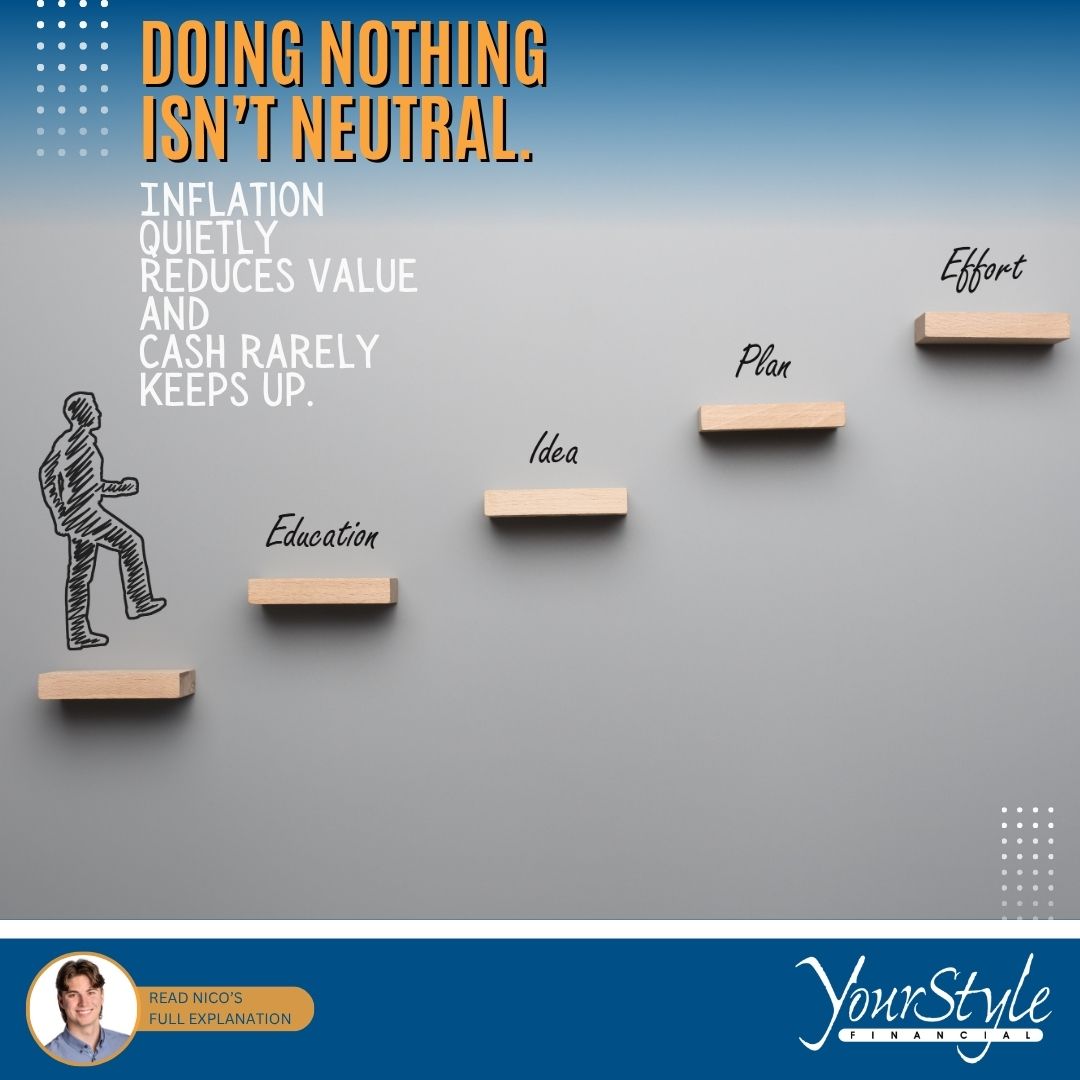
Doing nothing with your money isn’t neutral.
Over time, it can quietly cost you more than you think.
Inflation Is Always Working in the Background
Even when inflation feels “low” — say 2–3% — it’s still reducing what your money can actually do for you over time.
A simple way to think about it:
Nothing dramatic happens overnight.
But over years, the difference becomes meaningful.
The Opportunity Cost of Staying in Cash
Keeping money in a savings account might feel like the safest choice — but there’s a trade-off.
Historically:
That gap matters more than most people realize.
Here’s a simple example:
That’s not about taking unnecessary risk — it’s about understanding what happens when money doesn’t grow.
Time Is the Most Valuable Asset You Have
One of the biggest advantages anyone can have financially is simply starting earlier.
Even small amounts can make a significant difference over time.
To put this into perspective, here’s an example assuming a 7% annual rate of return over the long term:
Example:
Scenario A: Start Small, Then Increase Later
Results:
Scenario B: Wait, Then Invest More
Results:
These are hypothetical examples for illustration purposes, and actual returns will vary.
Even though the contributions are similar, the earlier start leads to a noticeably different outcome.
Not because of how much was invested — but because of time.
It’s Not About Taking Big Risks
This isn’t about putting everything into the market or making aggressive decisions.
It’s about balance.
For many people, the biggest risk isn’t volatility — it’s falling behind quietly without realizing it.
Final Thoughts
If your money is sitting in a savings account, you’re not doing anything wrong.
But it’s worth asking:
Is this working as well as it could for me?
Financial planning isn’t about pressure or quick decisions.
It’s about understanding your options and making choices that feel right for you.
If you ever want to talk it through — even just as a second opinion — I’m always happy to listen.
The Question We Get Asked All the Time
“How much do I need to retire?”
It’s one of the most common questions we hear — especially from people here in Winnipeg.
And almost every time, the conversation starts the same way:
“Is $1 million enough?”
“What about $3 million?”
“Should I be aiming for $5 million?”
It’s a fair question. But the honest answer is always the same:
It depends on the life you want to live.
The Problem With Chasing a Number
There’s a lot of noise out there about “the magic retirement number.”
The reality?
A number on its own doesn’t mean much.
$1 million could be more than enough for one person — and nowhere near enough for another.
Why?
Because retirement isn’t just a financial milestone.
It’s a lifestyle decision.
Start With This Instead: What’s Important to You?
Before we talk about dollars, we ask better questions:
Because once we understand that, we can map out the number.
Not guess it. Not estimate it broadly.
Actually plan it.
Winnipeg Matters More Than You Think
Working with financial planners in Winnipeg, we see firsthand how geography plays a role.
Cost of living, housing, taxes, and lifestyle expectations here are very different from Toronto or Vancouver.
That’s why generic advice doesn’t work.
Your plan needs to reflect:
What Actually Impacts “Enough”
When we build a financial plan, we’re not just looking at your investments. We’re factoring in:
Inflation
The cost of living doesn’t stay the same — especially over a 20–30 year retirement.
Taxes
How you draw income matters just as much as how you build it.
Fees
Even small percentages can have a meaningful impact over time.
Longevity
People are living longer — which means your money needs to last longer.
The Four Stages We Plan For
At YourStyle, we don’t just focus on retirement. We guide clients through every stage:
Accumulation
Building the foundation and developing good habits.
Growth
Maximizing opportunities while managing risk.
Preservation
Protecting what you’ve built as retirement approaches.
Transfer of Wealth
Ensuring your legacy is passed on efficiently and intentionally.
Because the goal isn’t just to retire.
It’s to do it with clarity and confidence.
So… Is $1M Enough?
It might be.
Or $3M might not be.
That’s the point.
There is no universal number. There is only your number.
And the only way to find it is through planning.
Live for Today. Plan for Tomorrow.
You don’t have to choose between enjoying life now and preparing for the future.
With the right plan, you can do both.
Let’s Build Your Plan
If you’ve been wondering whether you’re on track — or what “enough” really looks like for you — let’s have that conversation.
We’ll map it out clearly, based on your life, your goals, and your timeline.
👉 Connect with YourStyle Financial to start your personalized financial plan.
Because peace of mind doesn’t come from guessing a number.
It comes from knowing your plan.
— Doug
For many people, financial planning comes with a quiet hesitation.
Not because they don’t care — but because they’re unsure if they’re “ready.”
You might feel like:
Those thoughts are more common than you might expect.
But financial planning isn’t about where you “should” be. It’s about where you are — and what matters to you moving forward.
There’s No Perfect Starting Point
One of the most common misconceptions about financial planning is that you need to have everything in order before you begin.
In reality, there is no perfect starting point.
Some people come in with detailed plans and spreadsheets. Others come in with questions, uncertainty, or simply a sense that it’s time to start thinking about things differently.
Both are completely valid.
Financial planning should begin with understanding — not expectations.
A Different Kind of Conversation
At YourStyle Financial, the process doesn’t start with numbers.
It starts with a conversation.
There’s no pressure to have the “right” answers.
The goal is to create a space where you can talk openly, without feeling judged or evaluated. From there, clarity tends to follow naturally.
Progress Over Perfection
It’s easy to feel like financial decisions need to be perfect.
But most of the time, progress matters more.
Small, thoughtful steps taken consistently tend to have a greater impact than trying to get everything exactly right all at once.
Financial planning isn’t about fixing the past. It’s about creating a path forward that feels steady and manageable.
A Pace That Feels Comfortable
Everyone approaches planning differently.
Some people like detailed conversations and regular check-ins. Others prefer a quieter, more gradual approach.
There’s no single “right way” to plan.
For many, especially those who are more private or reflective, it’s important that financial planning happens at a pace that feels comfortable — without pressure or urgency.
The process should adapt to you, not the other way around.
What’s Important to You?
At the centre of financial planning is a simple question:
What’s important to you?
Not what the market is doing.
Not what someone else is prioritizing.
Not what you feel like you “should” be doing.
Just you.
Whether that means:
The role of financial planning is to support those priorities in a way that feels clear and achievable.
A Place to Start — Without Pressure
If you’ve been thinking about financial planning but haven’t been sure where to begin, that’s okay.
You don’t need to have everything figured out.
You don’t need to be at a certain stage.
You don’t need to feel “ready.”
If you’d like to have a conversation about where you are and where you’d like to go, you’re always welcome to reach out.
No pressure — just a place to start.
When you sign your mortgage documents, there’s often a moment where you’re offered mortgage insurance through the bank. It can feel convenient. Simple. Almost automatic.
But it’s important to pause and ask a gentle question:
Who is this coverage truly protecting?
This conversation has come up more often lately, especially following Doug’s recent thoughts on ManuOne and ownership. And I think it’s an important one — because protection should always be centred around your family.
The Key Difference: Who Benefits?
Bank mortgage insurance is designed to pay off your mortgage directly to the lender if something happens to you.
That means the bank receives the funds.
Your family receives a mortgage-free home — which can certainly help — but they do not receive control over the money itself.
With personally owned life insurance, it’s very different.
You:
If something happens, the benefit is paid directly to the people you love. They can use it to pay off the mortgage, replace income, cover education costs, or manage day-to-day living expenses.
Personal insurance protects your family.
Mortgage insurance protects the bank.
That distinction matters.
Underwriting: When It Happens Makes a Difference
Another important difference is when the underwriting occurs.
With personally owned life insurance, underwriting is completed upfront, when you apply. You know you’re approved. You know the terms. There are no surprises later.
With many bank mortgage insurance policies, underwriting is often completed at the time of claim. This can result in delays — and in some cases, even denial of the claim if something in your health history raises questions.
In a time of grief, your family should not be navigating uncertainty.
Clarity and certainty bring peace of mind.
Cost and Flexibility
Many people are surprised to learn that personally owned life insurance can:
Bank mortgage insurance is typically tied to your mortgage balance — meaning as your mortgage decreases, your coverage decreases, but your premium often stays the same.
With personal coverage, your protection amount remains consistent for your loved ones.
Protection Should Reflect What’s Important to You
At YourStyle Financial, we believe insurance isn’t about paperwork — it’s about people.
It’s about ensuring your family has options, stability, and breathing room during a difficult time.
Mortgage insurance may feel convenient. Personally owned life insurance feels intentional.
If you’re unsure what you currently have, or if you’ve never compared the two, I’m always happy to sit down and review it with you. There’s no pressure — just clarity.
Because protection should always be built around what’s important to you.
— Samantha
If you’ve heard someone say “the next generation will never be able to afford a home”, you’re not alone. Housing affordability is one of the biggest financial concerns facing Canadians today—especially young families, small business owners, and people working in agriculture where income can be seasonal or unpredictable.
That’s exactly why the First Home Savings Account (FHSA) exists.
As a newer financial planner, I’m often surprised by how many people haven’t heard of the FHSA yet. It’s one of the most generous tools the Canadian government has ever introduced for first-time home buyers—and when used properly, it can make a meaningful difference.
Let’s break it down in plain language.
What Is the FHSA?
The FHSA is a registered savings account designed specifically to help Canadians save for their first home. It combines some of the best features of both an RRSP and a TFSA:
In other words, you get a tax break going in and coming out—something that’s extremely rare.
Who Is Considered a Qualified First-Time Home Buyer?
You may qualify even if you’ve owned a home in the past.
You are considered a qualified first-time home buyer if:
This definition is broader than many people expect, which is why it’s worth checking before assuming you’re not eligible.
FHSA Contribution Rules (This Part Is Important)
Here’s where timing really matters.
This means if you’re eligible and planning to buy a home someday—even if it’s far off—it can make sense to open an FHSA sooner rather than later.
And yes, contributions are tax deductible, which can be especially helpful for individuals with fluctuating income, such as farmers, ag professionals, and small business owners.
How FHSA Withdrawals Work
When used properly, FHSA withdrawals are very flexible and very tax-efficient.
Using Your FHSA to Buy a First Home
Used correctly, this can significantly reduce the amount you need to borrow.
What If You Don’t End Up Buying a Home?
Life doesn’t always follow the original plan—and the FHSA accounts for that.
If you don’t use your FHSA to buy a home:
This flexibility makes the FHSA low-risk and highly adaptable.
Why the FHSA Matters—Especially Right Now
With rising home prices, higher interest rates, and ongoing conversations about affordability, the FHSA gives Canadians a real, practical advantage—not just hope.
For younger Canadians, it creates a structured way to save.
For those in agriculture or self-employment, it offers tax flexibility.
For everyone, it’s a reminder that smart planning still matters.
Final Thoughts
The FHSA is one of those tools that doesn’t get nearly enough attention—but it should. Whether you’re actively planning to buy a home or just trying to keep future options open, understanding how the FHSA works is an important first step.
As a financial planner, my goal is to help people turn complex rules into clear, confident decisions—and to make sure opportunities like this don’t get missed simply because they weren’t explained well.
If you’re unsure whether the FHSA fits your situation, or how it works alongside other tools like TFSAs and RRSPs, I’m always happy to talk it through.
Second opinions are welcome.
This is a sensitive topic — and an important one.
Recently, I was asked a thoughtful question about how changes in life expectancy and the growing use of Medical Assistance in Dying (MAID) might affect life insurance premiums and payouts.
It’s a professional question — but also a deeply personal one.
So let’s walk through this carefully.
Canadians Are Living Longer
Life expectancy in Canada has indeed increased significantly over the past century. According to Statistics Canada, Canadians today live substantially longer than they did in the early 1900s.
However, it’s important to clarify something:
Life expectancy has increased gradually over decades — largely due to advances in medicine, sanitation, and chronic disease management. It has jumped by 20 years in just two generations, however it fluctuated slightly during COVID.
Insurance companies already price policies using updated mortality tables. Longevity trends are not a surprise to the industry — they are built into actuarial modelling.
What Is MAID?
Medical Assistance in Dying (MAID) became legal in Canada in 2016 under federal legislation. It allows eligible individuals, under strict medical and legal criteria, to request medical assistance in dying.
It is not the same as a general “suicide clause,” and that distinction matters greatly in insurance.
Is MAID Treated as Suicide in Life Insurance Policies?
This is the question most people want clarity on.
In Canada, most life insurance policies contain a suicide exclusion clause, typically stating that if the insured dies by suicide within the first two years of the policy, the benefit may not be paid (or premiums may be refunded).
However:
MAID is legally distinct from suicide under Canadian law.
As of today, most major Canadian insurers treat a death under MAID the same as any other natural death — provided:
• The policy has been in force beyond the suicide exclusion period (usually 24 months)
• There was no material non-disclosure at the time of application
• The individual qualified legally under MAID legislation
That said, policy wording matters. Each insurer’s contract language is what ultimately governs payout.
Could Premiums Increase Because of MAID?
At this time, there is no clear evidence that MAID has directly caused increases in life insurance premiums.
Insurance pricing is based on large-scale actuarial modelling, and while MAID is factored into mortality statistics, it represents a relatively small percentage of overall deaths in Canada.
Insurers adjust pricing based on:
It is unlikely that MAID alone would dramatically alter premiums industry-wide — but insurers continually monitor mortality data.
A Word About Some Of The Numbers Circulating
There are many statistics being shared socially about MAID — particularly regarding usage rates in care homes and the projected healthcare savings.
It’s important to approach these figures carefully.
While the federal government has acknowledged cost implications in policy discussions, MAID legislation was not introduced as a cost-saving measure. It was framed around autonomy, medical ethics, and end-of-life rights.
Any financial projections about long-term healthcare savings remain estimates — they are not guaranteed fiscal outcomes.
As planners, we focus less on speculation and more on documented contract language and current underwriting standards.
What Matters Most For Policyholders
If you have life insurance and are concerned about how MAID could affect your policy, here’s what I recommend:
The Bigger Picture
This is not just a financial topic. It touches ethics, autonomy, family dynamics, and deeply personal decisions.
Insurance exists to create certainty during uncertain times. The goal is not to speculate — it’s to understand how your specific contract works within today’s legal framework.
If this is a question on your mind, let’s review your policy together and ensure there are no surprises.
Because clarity brings peace of mind — and that matters.
For many people, the idea of meeting with a financial advisor can feel intimidating.
You might wonder:
If any of those thoughts feel familiar, you’re not alone. Many people in Manitoba delay financial planning simply because they aren’t sure what the experience will actually be like.
The reality is, working with a financial advisor doesn’t need to feel overwhelming or uncomfortable. When done properly, it should feel steady, clear, and centred around one simple question:
What’s important to you?
Why Financial Advisors Can Feel Intimidating
There are a few common reasons people hesitate to reach out:
If you’ve ever felt that way, it’s completely understandable.
Financial planning is personal. It involves your goals, your habits, your priorities, and sometimes your uncertainties. It should never feel like an interrogation or a performance review.
What Working With a Financial Advisor at YourStyle Actually Looks Like
The process is simpler than many people expect.
1. It Starts With a Conversation — Not a Presentation
The first meeting isn’t about charts or projections.
It’s about understanding you.
There’s no pressure to have everything prepared. You don’t need to “know enough.” The goal is simply to start a conversation in a way that feels comfortable.
2. Clarity Before Complexity
Financial planning doesn’t need to be complicated to be effective.
Rather than overwhelming you with terminology or technical details, the focus is on helping you understand what matters most and what steps make sense next.
That might include:
The pace is steady and thoughtful. Questions are always welcome.
3. A Comfortable, Judgment-Free Environment
Many people worry they’ll be told they should have started sooner, saved more, or structured things differently.
That’s not helpful.
Everyone’s path looks different. Life happens. Careers change. Families grow. Priorities evolve.
Financial planning should meet you where you are — not where someone thinks you “should” be.
The goal is to create clarity and confidence, not pressure.
4. Ongoing Support That Reflects Your Comfort Level
Some clients prefer regular check-ins. Others prefer fewer meetings with time to reflect between conversations.
There isn’t a single “right” way to plan.
The process adapts to your personality, your pace, and your preferences. For those who are naturally more introverted or private, planning can be structured in a way that feels calm and manageable.
Financial planning should fit into your life — not take it over.
What’s Important to You?
At the end of the day, financial planning isn’t about outperforming markets or chasing complexity.
It’s about helping you make decisions that support what matters most in your life.
Whatever that looks like for you, it starts with a conversation.
If you’ve been feeling hesitant or unsure about what working with a financial advisor looks like, know that it doesn’t need to feel intimidating.
If you’d like to learn more about the process or simply have an initial conversation, you’re always welcome to reach out. There’s no pressure — just a place to begin.
As RRSP season arrives, many people feel a familiar mix of intention and uncertainty. You know saving for retirement matters — but life is busy, priorities compete, and it’s easy to wonder whether contributing now will really make a difference.
With the RRSP contribution deadline of March 2, 2026, this is a gentle reminder that even a thoughtful contribution today can support both your future lifestyle and your current tax situation.
What an RRSP Really Does for You
A Registered Retirement Savings Plan (RRSP) is designed to help you build long-term financial security — but its benefits extend well beyond retirement.
When you contribute to an RRSP:
For many Canadians, RRSP contributions result in a tax refund — money that can be reinvested, used to reduce debt, or set aside for other meaningful goals.
Why Timing Matters Right Now
RRSP contributions made before March 2, 2026 can be applied to your 2025 tax year. This means you still have time to make a decision that may ease the tax pressure you’re feeling today — while quietly strengthening your long-term plan.
Even if you’re unsure how much to contribute, starting the conversation now allows us to:
There’s no one-size-fits-all answer — and that’s okay.
RRSPs Are About More Than Retirement
At YourStyle Financial, we believe financial planning is personal. An RRSP isn’t just about numbers on a statement — it’s about creating options, reducing stress, and feeling more confident about the road ahead.
Whether retirement is decades away or just around the corner, the right RRSP strategy can support the life you want to live — now and in the future.
If you’ve been meaning to look at your RRSP but haven’t had the chance, this is a wonderful time to reach out. I’m always happy to talk through your questions and help you make a decision that feels right for you.
— Samantha
A Different Way to Think About Your Mortgage and Debt
When people think about mortgages, the conversation usually starts and ends with one question: What’s the rate?
(more…)
Getting married is an exciting step — one that comes with new conversations, shared goals, and a future you’re beginning to shape together. Alongside planning a wedding or settling into life as a couple, many people start thinking about finances and wonder where to begin.
(more…)Part 7 of 7 | Financial Wellness Series
In the final episode of our Financial Wellness Video Series, Doug Buss, founder of YourStyle Financial, joins Rafiq Punjani from Right at Home to discuss how thoughtful tax planning can help families keep more of what they’ve earned — while also supporting the causes that matter most to them.
(more…)
Part 6 of 7 | Financial Wellness Series
In the sixth installment of our Financial Wellness Video Series, Doug Buss, founder of YourStyle Financial, joins Rafiq Punjani from Right at Home to discuss one of the most important questions private caregivers can ask:
👉 “What are the signs we should look for that might signal concern?”
Part 5 of 7 | Financial Wellness Series
In the fifth episode of our Financial Wellness Video Series, Doug Buss, founder of YourStyle Financial, joins Rafiq Punjani from Right at Home to discuss some of the most common mistakes families and private caregivers make — and how to navigate those challenges with financial awareness and compassion.
(more…)
Part 4 of 7 | Financial Wellness Series
In the fourth episode of our Financial Wellness Video Series, Doug Buss, founder of YourStyle Financial, joins Rafiq Punjani from Right at Home to talk about how to provide meaningful support for elders who are beginning to need help — while maintaining their independence, confidence, and dignity.
(more…)
Part 3 of 7 | Financial Wellness Series
In the third installment of our Financial Wellness Video Series, Doug Buss, founder of YourStyle Financial, joins Rafiq Punjani from Right At Home to talk about what happens when someone reaches out for help because they’re struggling financially — particularly later in life.
(more…)
Part 2 of 7 | Financial Wellness Series
In the second installment of our Financial Wellness Video Series, Doug Buss, founder of YourStyle Financial, joins Rafiq Punjani from Right At Home to discuss an important topic — the financial tools available to families and private caregivers who want to help their loved ones remain at home for as long as possible.
(more…)