

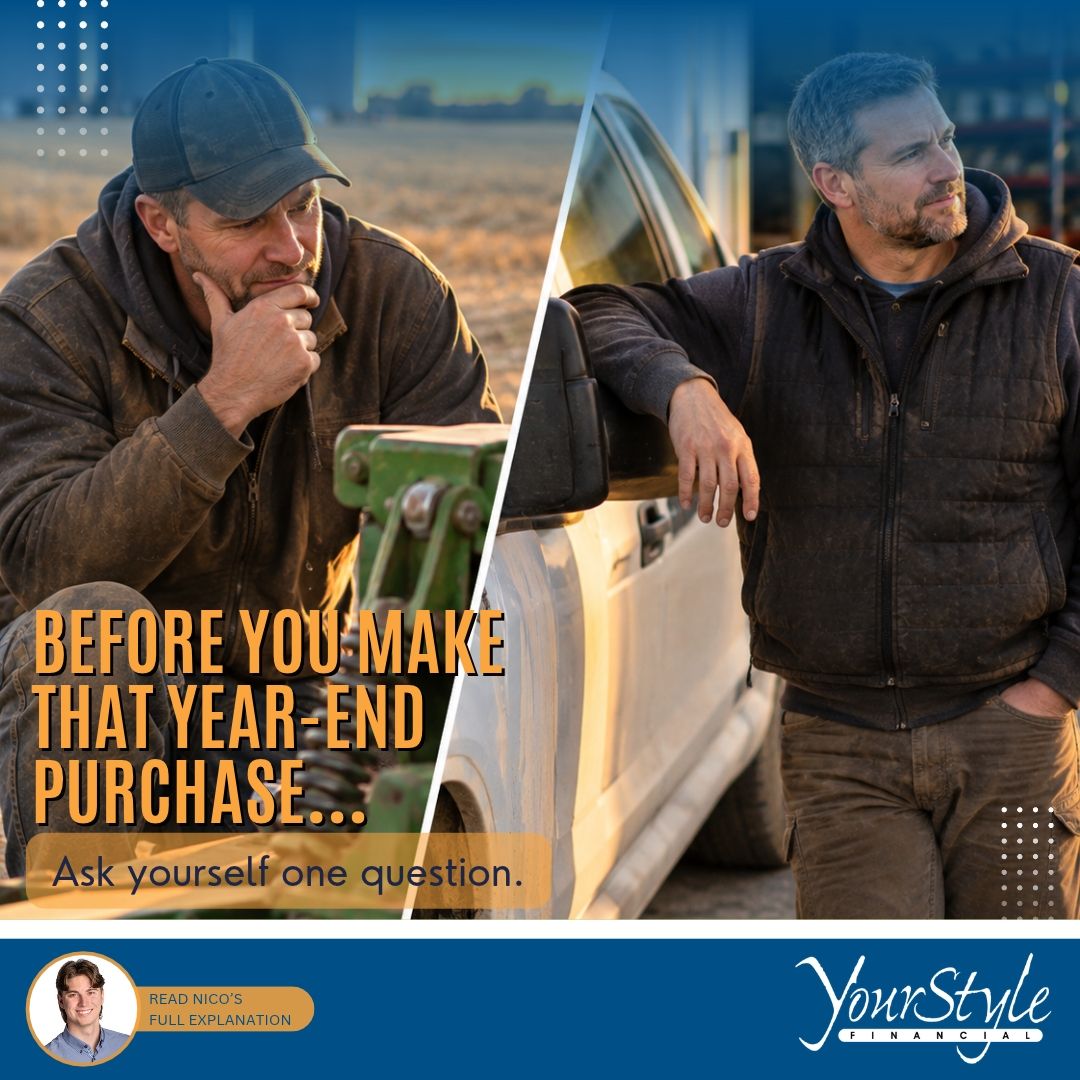
Before You Make Another Year-End Purchase, Ask Yourself Why
By Nico | YourStyle Financial
As we get closer to the end of the year, there’s a conversation I hear quite often from business owners and farm families.
“I should probably buy something before year-end to save on taxes.”
Maybe it’s a new truck.
Another piece of equipment.
Upgrades to the shop.
Or something that’s been on the wish list for a while.
And sometimes, making that purchase before year-end makes perfect sense.
But I think there’s an important question worth asking before you spend the money.
Would you still make that purchase if there wasn’t a tax benefit?
It’s a simple question, but it can change how you look at the decision.
A Tax Deduction Doesn’t Make Something Free
I think this is one of the biggest misconceptions around year-end business spending.
If you purchase something for your business, you may be able to claim a deduction or capital cost allowance, depending on the type of purchase and applicable tax rules.
But that doesn’t mean you’re getting the money back.
Let’s use a simplified example.
Say you spend $10,000 on an eligible business expense that is fully deductible in the current year.
If that deduction reduces your income taxes by $3,000, you’ve still spent $7,000 after the tax savings.
That may be money well spent if the purchase helps your business operate more efficiently, increase productivity or generate additional revenue.
But if you’re buying something simply to reduce your tax bill, it’s worth looking at the bigger picture.
Saving on taxes and making a good financial decision aren’t always the same thing.
And remember, not every purchase qualifies for an immediate full deduction. Equipment, vehicles and other capital assets may have different tax treatment, so it’s important to review the details with your accountant.
What Does the Business Actually Need?
When you operate a farm or small business, there’s almost always something you could spend money on.
I grew up around rural communities, and I understand that equipment isn’t just something you own. It’s something you depend on.
The same is true for a contractor’s truck, a manufacturer’s machinery or a business owner’s technology.
Sometimes replacing or upgrading something is absolutely necessary.
But before making a significant year-end purchase, I’d encourage you to ask yourself a few questions:
- Is this something I need now? Or could it reasonably wait?
- Will it improve the business? Will it save time, reduce costs, improve reliability or create new opportunities?
- How will I pay for it? Am I using cash, financing the purchase or taking on additional debt?
- What else could that money be used for? Are there other business or personal financial priorities that deserve attention?
- Does this purchase fit my longer-term goals? Or am I making the decision primarily because the calendar says December?
There aren’t necessarily right or wrong answers.
The point is to make sure you’re purchasing something for the right reasons.
Don’t Forget About Cash Flow
A business can be profitable on paper and still experience cash flow challenges.
That’s especially true for businesses with seasonal revenue or significant operating expenses.
For farm families, income and expenses can vary considerably depending on the growing season, commodity prices and the timing of sales.
Other small businesses may experience similar challenges when customers delay payments, projects slow down or unexpected expenses arise.
Making a large purchase before year-end might provide a tax benefit, but it can also reduce the cash available to operate the business in the months ahead.
And if you’re financing the purchase, there may be additional interest costs and ongoing payments to consider.
A good purchase should make sense for your business beyond December 31.
What About Your Personal Financial Goals?
This is where I think financial planning can bring another perspective to the conversation.
As we discussed in my previous blog, Your Business Had a Good Year. Did You?, business success doesn’t always translate into personal financial progress.
It’s easy to keep reinvesting every available dollar into the business.
And sometimes that’s exactly what you should be doing.
But it’s also worth considering whether some of that money could help you make progress toward personal goals.
Maybe that’s building an emergency fund.
Contributing to retirement savings.
Reducing personal debt.
Investing outside the business.
Or simply creating a little more financial flexibility for your family.
The right decision depends on your circumstances, your business structure and your goals.
I’m not suggesting you should choose personal investments over a necessary business purchase.
I’m suggesting that both deserve a place in the conversation.
Your Accountant and Financial Planner Should Be Part of the Same Conversation
Your accountant plays an important role in helping you understand the tax implications of business decisions.
A financial planner can help you consider how those decisions affect your broader financial goals.
For example, a purchase may make sense from a tax perspective but create challenges for your cash flow or retirement savings.
Or it might be a smart investment in the business that supports your longer-term financial security.
That’s why I believe it’s valuable to have those conversations before making significant decisions, rather than trying to figure everything out afterward.
The goal isn’t simply to pay less tax this year.
It’s to make decisions that support both the business and the life you’re building around it.
Before You Spend, Think About What You’re Building
As another year comes to an end, there will always be opportunities to spend money on your business or farm.
Some will be necessary.
Some will be smart investments.
Others might be worth reconsidering.
And that’s okay.
You don’t have to make every financial decision perfectly.
But taking the time to understand why you’re making a purchase, how it affects your finances and whether it moves you closer to your goals can make a meaningful difference over time.
Let’s Start a Conversation
If you’re a Manitoba business owner or part of a farm family and you’re looking at year-end purchases, investments or financial decisions, I’d love to sit down with you.
You don’t need to have all the answers or know exactly what you should be doing.
Tell me about your business, what you’re considering and what you’re hoping to accomplish.
We can look at how those decisions fit into your overall financial picture and identify where planning might help. And where tax questions are involved, we can work alongside your accountant to make sure the pieces fit together.
If you’ve been making financial decisions for your business but haven’t spent much time looking at what they mean for you personally, let’s start that conversation.
I’d be happy to meet for a coffee.
This article is for general information only and is not individualized financial or tax advice. Tax treatment depends on the nature of the expense, business structure and applicable rules. Consult qualified professionals before making significant financial or tax decisions.