
YourStyle Financial

News

There Are Two Certainties in Life and One is Taxes

February 14, 2018

It’s the time of year where the working world is split into those that look forward to tax refunds and those who dread seeing how much they owe. Yes, that’s right, it’s tax time. The buzz has begun with the distribution of T4s, which companies have until the end of February to deliver. Tax returns are one of those things in life that are necessary, but are never really reviewed. It’s a wonder there isn’t a life skills course offered in high school which covers real life lessons such as budgeting, tax requirements and filing, resume writing, interview skills and grocery shopping. Now is the time to gather all the documentation you need to prepare your taxes.  These include slips such as T4, T4A, T4E, T5, T5007, receipts and certificates. While most personal tax returns are filed electronically, paper copies or records must be retained and available for CRA by request. One of the tax reduction options still available is RRSP contributions. The deadline for RRSP contributions for the 2017 tax year is March 1, 2018. It’s important to keep track of your RRSP contributions to ensure you don’t go over the limit and incur over-contribution penalties. While you are allowed a lifetime over-contribution of $2000, it’s best to carry any overages into the next tax year. Investments are another unclear area for most people. There are a multitude of qualified RRSP investments available such as segregated or mutual funds, stocks, bonds, ETFs and GICs. It’s important to have a diversified portfolio. In other words, don’t put all your eggs in one basket. If you haven’t before, this would be a great time to talk to a professional financial advisor. Financial Planners understand all the benefits and risks of each of these options and which would be best suit you and your stage in life. Now that we’ve talked about planning for the upcoming tax season, stay tuned for more advice on tax saving opportunities.

A New Year, a New Financial Plan

January 17, 2018

The holidays are over and the celebrations are complete. Now it’s time to look forward to the new year and all the opportunities it brings. When it comes to resolutions, the focus always seems to centre around appearances and hitting the gym. Perhaps this year it’s worth thinking about hitting the financial plans.

There are a few simple steps you can take on your own to improve your financial situation. The obvious one, of course, is to get control of your spending.  While that seems simple enough, it’s surprising how overwhelming this can seem. So start with the basics. Make a list of all your required monthly expenses; not your wants, but your must have’s.

Include things such as:
–    Rent or mortgage payment
–    Home or renter insurance
–    Property taxes
–    Utilities including hydro, phone, internet, tv
–    Auto insurance
–    Fuel and/or bus pass
–    Food

Once you’ve calculated all your required expenses, subtract that from your net income for the month. Now you know what you have to put aside every month just to get manage your obligations and how much you have left to make decisions on. From here, set an entertainment budget. In the days of digital currency, it’s easy to tap your bank card into debt. One tip is to withdraw your entertainment money in cash on every pay date and then store your bank card. Once the cash is gone, you know you need to find free entertainment options.

Now that you’ve covered the basics, it’s time to think bigger picture. What do you want your money to do for you? The options to achieve your goals are quite vast and you want to make sure you’re making the responsible choice to attain them. If you’re looking at larger purchases or long-term financial planning, this might be the right time to talk to a professional. Financial Planners are able to look at the entire picture and present the best options for your dollars. Not only is it okay to ask for help, it’s the first step in the progression of the new you.

We’d love to help you with your resolutions. Give us a call or contact us today.

Struggling with Finances? You’re Not Alone

December 12, 2017

When you’re sitting at the table shuffling through a stack of bills, or you’re scared to check your email for fear of finding new bills, it’s easy to think you’re all alone.  It’s natural to become overwhelmed and believe there is no way to dig yourself out of your current position. This type of thinking plays directly into your perception of yourself and your self-worth.
Manulife has been studying the link between health and wealth since 2014. What they’ve found was in 2015, financial wellness was connected to productivity. In 2016, it showed that 40% of Canadians are financially unwell. I guess you’re not so alone after all…
In 2017, what has come to light through speaking with professional counselors is there are emotional barriers to financial wellness. People are embarrassed to share their financial woes, are ashamed and feel like they’ve failed. More than half the time people seek help, financial troubles are a part of it and only 1/3 of them see the connection between their financial struggles and their other challenges.
Financial worries can lead to physical manifestations of stress and create or amplify mental health concerns. This level of stress impacts the ability not only to be productive in the workplace, but sometimes to attend the workplace at all. In an average week, 500,000 Canadians miss work, and a whopping 30% of disability claims and 70% of disability costs are associated with mental health issues and illnesses.1
Organizations have the opportunity to provide resources to help. With the right group benefits plan and provider, employees can have access to comprehensive health benefits which include both physical and mental programs. Many of these plans also promote financial well-being and preparedness.
YourStyle Financial is an independent group benefits consulting firm. We offer a range of services geared to help our clients maximize the strength of the dollars they spend on benefits. Schedule a lunch and learn today or contact us.

‘Tis the Season… To be Penny-Wise

November 23, 2017

No, not the creepy clown from IT, more like Uncle Pennybags. As we head into the holiday season, it’s easy to fall into a spending spree with no regard for your financial state. In a time when wish lists are pervasive and the urge to impress is rampant, it’s more important than ever keep an eye on your bank balance. There are many ways to manage your holiday spending. The first step seems an obvious one – set a budget. Write down the list of people you need to buy for, those you like to buy for, your last minute “oh I got you something too” gifts and don’t forget all the incidentals such as food and decorations. Once you know how many gifts you need, set a reasonable amount of money you can afford without incurring unmanageable debt. Now you know how much you have to spend and how many gifts you need to buy. Set a number beside each person and item. Bring this with you when you go shopping and be sure to check it twice. The aforementioned plan is a great way to address holiday spending, however, an added step to this would be to start saving ahead of time. Start a holiday fund at the beginning of the year to help reduce the financial strain at the end of the year. It’s surprising how fast $20 per cheque can add up and how little you would miss it. If you put $20 per cheque in your stocking, by December you would have approximately $440 of disposable income. That’s a lot of cash with very little effort. Another area to be attentive to is holiday socializing. It’s surprising how these events can add a lot of cost to those who are hosting. Why not create an environment that is more in line with the spirit of the season and have everyone bring something? That helps distribute the cost and makes it more enjoyable for all those attending. While it is the season for giving, it’s important to remember to give to yourself. Your gift should be the gift of financial freedom. If you would like a little help on this, contact us.

Snowbirds Fly the Coop to Escape the Cold

November 01, 2017

For as long as memory serves, Canadians of retirement age have been moving south for the winter to escape the cold. This group of people are lovingly referred to as snowbirds. Despite the state of the dollar, Canadians are still holding to this practice. They are also one of the few groups of “foreigners” who are being welcomed by the United States.  Tourism from Canada spurs job growth in the destination towns across the US aiding in their economy. Not to mention that Canadians purchase 6% of all homes sold in Florida, therefore injects nearly half a billion dollars in property taxes per annum.

Most likely due to these factors, the US has tabled a bill to allow Canadians over the age of 55 to stay for up to eight months of the year. While congress wants Canadians to stay longer, the IRS wants to ensure it collects what it can. Currently stays of four months or less have allowed Snowbirds to maintain their US tax exempt status. The new formula is based on this:

(more…)

Planning for the Unexpected in Today’s World

October 05, 2017

In 2017 the world has experienced some extremely traumatic events; many centered around major tourists areas. Many people were injured and killed in cartel related shootings in Mexico and most recently the tragic mass shooting in Las Vegas. We have even experienced suspected terrorist activities in Canada with the recent attack in Edmonton. Our hearts and sympathies go out to all those affected indirectly and directly by these events. While we like to believe these circumstances will never happen to us, the sad reality is they can happen to anyone, anywhere. This is why it’s so important to plan for the unexpected. Most travellers don’t realize how essential travel insurance can be to both their present and their future. Imagine just flying out for the weekend to enjoy a good time with your family or friends. Now imagine you are being transported to the hospital due to accident, violence or medical issues. Do you want to experience the panic of realizing you could be responsible for tens if not hundreds of thousands of dollars of medical bills? Or would you rather focus on your current situation and your healing? Travel insurance can make the difference between those two scenarios. If you’re not thinking about yourself at that moment, have you thought about the impact a tragedy of this nature could have on your family? For one of the Manitoba victims of the Las Vegas massacre, her husband and son are on their way to be with her during her recovery. This is going to involve time off work, flights costs, hotel and food. Were you aware many travel insurance plans provide for these types of costs? Now imagine the worst case scenario (something we all avoid facing), and that is you do not survive. Now your family must not only arrange to transport you home, but also address possible outstanding medical bills. This, at a time when they should be focusing on grieving and healing. In addition to travel insurance, this is another reminder of the necessity for will and estate planning. Choosing someone to be in charge if you become mentally incapacitated and after you die and deciding who will get what, when they will get it, and how they will get it after you’re gone will go a long way towards avoiding family conflict and costly court proceedings. The world is an unpredictable place, but planning your finances and insurance is something within your control. If this is something you are ready to address, we’d be happy to help.

Financial Planning due to divorce

Divorce Debt and Next Steps

September 19, 2017

We’ve covered how to financially survive a divorce and dividing assets, now it’s time to get down to the brass tacks – debt. Some couples come into a marriage with debt, as we talked about in one of our blogs “So You’re Getting Married”, and some couples accrue debt during their marriage. Either way, when a marriage comes to an end, that debt must be dealt with. One approach to addressing marital debt is to pay it off before filing for divorce. This requires a couple who can speak candidly to each other regarding this topic as well as two people who are willing to accept that debt is generally mutually created and accept joint responsibility. More often than not, this situation is just not a reality. Debt is quite often a major instigator of marital breakdown.

(more…)

Dividing Assets During Divorce

August 15, 2017

A couple of weeks ago, we talked about how to financially prepare for divorce. Facing the topic head-on, while it’s a tough row to hoe, knowing you’re not alone can help. According to Stats Canada, 43% of marriages end in divorce before the 50th anniversary. Reading that, you may think “Who would divorce after being married that long?”. The answer is anyone. Life affects everyone and when you share your life with someone, it affects them too. While knowing this doesn’t make preparing for the emotional impact of divorce any easier, planning your financial decisions ahead of time can put you in a better position to move forward. In life, moving on is the key to moving forward.

(more…)

How to Financially Survive Divorce

July 27, 2017

Most people have been exposed to divorce either directly or indirectly and can attest to the impact it has on all involved. Some people avoid the couple and some get far too involved. One of the most damaging aspects of divorce is the financial damage that can be caused if you don’t address the money side as soon as possible.
A “friend of a friend” had been married for a number of years when they found out their spouse was cheating. Emotionally devastated, this friend didn’t know the steps to take to protect themselves. So while they sorted through how they felt and where they wanted to go, their spouse was spending all their money and amassing a large amount of debt. By the time next steps were decided, this friend was now financially responsible for half of the debt.
If this were you, would you know the steps to protect yourself from that level of financial destruction? Did you know if you are directly involved in a divorce, one of the people that can help is your Financial Advisor. At YourStyle Financial, we can help you organize your financial information which will allow you to effectively and efficiently work with your spouse and lawyers. This can also help reduce legal fees, which assists in financial recovery. We’ll start the conversation with a Checklist-divorce-2017 and go from there.
This is just an inch in the well of information and assistance we are able to offer. We’ll be writing again soon on dividing assets and dealing with debts. If you think we can help, be sure to contact us in the early stages of potential separation or divorce.]]>

Why Millennials Need Life Insurance

April 17, 2017

If you’re young and single, you may think that the things you want out of life are attainable with persistence and planning, and that you have lots of time.
But the reality is, you just never know about that last part.
This is why you might want to put life insurance — a financial product often overlooked by young adults — on your radar.

Don’t Dismiss It

Fewer than 20% of millennials say they’re likely to buy life insurance. 60% say Internet, cable and cellphone bills are higher priorities, while about 3 out of 10 millennials say saving for a vacation is more important than buying life insurance.
But just because you’re a young, healthy single with no children doesn’t mean you should disregard the need for life insurance coverage.
Just think… what would happen to the people you love is something were to happen to you?

Why You May Need (More) Life Insurance

If you offer some financial support to your parents or other relatives, or if you fall into the majority of young adults with sizable student loan debt, you ought to think about life insurance. Keep in mind, for example, that if someone has co-signed on a loan for you, the obligation could fall on your co-signer to pay off your debt if you are no longer around.
Chances are you already have some life insurance — group coverage — if you’re working full time. But do you need to go out and buy more coverage?
To answer that question, you must calculate how much your family would need if you were suddenly out of the picture.

Assessing Your Coverage Needs

You must consider:

  • How much money your family would need to cover funeral expenses if you were to die unexpectedly.
  • How much would be needed to replace any income that you’re contributing to your family.

When dealing with the loss of a loved one, the emotional side is a big enough struggle. If you can take the financial struggle off the table, it makes it much easier for the surviving family members to focus on just the emotional side.
Term life insurance may be the best option for a 20-something on a budget. It covers you for a determined time period, such as 20 or 30 years, and is relatively low-cost.
You can get a lot of coverage from an excellent insurance company for very little money.

Term vs. Permanent

Another option is permanent life insurance, which costs more than term but covers your entire life.

Do Your Homework

Life insurance can be hard to understand. Usually, it’s a lack of knowledge that prevents young adults from being more secure in their financial situation.
So, read up — like you’re doing now. And be sure the insurance company you select is financially solid.
This is probably going to be a 20-year relationship, so go with a highly rated company.
Most of all, keep it simple. Focus on the need to replace that lost income. There are a lot of complicated products out there.
If you have any questions about this topic, please contact Yourstyle Financial to discuss more!

Insurance Protection Info From QUS

October 25, 2016
  • No strenuous exercise for at least 24 hours before and after the exam.
  • Be well rested.
  • If applicant has a cold, menses or flu – reschedule!
  • Limit alcohol for 24 to 48 hours prior to exam.
  • Limit caffeine.
  • Reduce smoking.
  • Ideally fast for 4-8 hours before the exam depending on the Insurance Company requirements. If there have been prior health issues, a 12 hour fast may be required.
  • Avoid vitamins and supplements for 24 hours.
  • Continue all prescribed medications.
  • RELAX!

QUS is pleased to provide nine one-minute videos to help clients prepare for their insurance medical. These videos are the first of any paramedical provider in Canada! You will find everything you need to know – how long the appointment will take, important tips, as well as specialized information for specific tests. Please visit https://getready.qus.ca  for more information.

Wawanesa Insurance Walk To Fight Arthritis

September 20, 2016

YourStyle Financial was at the Wawanesa Insurance Walk to Fight Arthritis in Winnipeg on Sunday, June 5, 2016! The Walk to Fight Arthritis stretches across Canada to unite families, friends and organizations to achieve one common goal: to help the over 4.6 million Canadians, who live with arthritis every day. This figure includes more than 200,000 Manitobans, from infants to seniors. Arthritis has no cure. The Arthritis Society builds awareness and raises funds for arthritis research. Fundraising for the Walk also permits The Arthritis Society to keep providing vital programs and services that enable people with arthritis to live well at home, work and play. “We are grateful for YourStyle Financial’s support of the Walk,” says Donna Wills, Regional Manager for Manitoba/Nunavut.  “YourStyle sponsored the event, helped promote the event in their newsletter and entered a very energetic team! They were among the almost 500 walkers who raised nearly $65,000 for, The Arthritis Society, Prairie Division – Manitoba/Nunavut. THANK YOU YourStyle!”

Insurance For Newlyweds

May 20, 2016

Joint policies may seem attractive because of the cost savings. But it doesn’t cost much more to insure each life individually, and you or your spouse receives double the payout. For example, if you and your spouse are 30 years old, a joint 10-year term first-to-die policy worth $1 million insures both of you and costs about $787 annually (2014 rates). The contract pays out upon the first insured’s death to the surviving spouse. However, you could purchase two $1-million contracts for an annual premium of about $849. And the total payout from both contracts would be $2 million. Complications with joint policies can arise if your marriage falls apart. A divorce doesn’t invalidate a contract, so if you forget to cancel it, your ex-partner could receive an unintended death benefit. Also after divorce, you and your spouse may have to purchase insurance individually (depending on the type of original policy), and if either you or your spouse’s health has worsened, it may be difficult to get new coverage. Already insured Your parents may already have bought you life insurance. In that case, parents usually pay the premiums and are the beneficiaries. The parents own the contract and you are usually appointed as contingent owner. If the parent dies, the ownership automatically reverts to you, the insured child. When you marry, the family needs to discuss when you should take over the premiums based on financial ability, and whether the beneficiary should be changed to the new spouse. Subsection 148 (8) of the Tax Act allows a tax-free rollover from a parent to a child insured under a life insurance policy. Your uninsured spouse should also purchase a policy, even if he stays at home to care for children, since you would have to pay for childcare if he dies unexpectedly. If you can’t afford permanent insurance for the uninsured spouse, you can purchase term insurance and convert it when your finances are healthier. Make sure the policy you choose has this feature. Health insurance If both you and your spouse work, your advisor can help you decide whether to opt out of one of your health plans. For instance, if you have a 50% co-pay in your health plan and your spouse is fully covered, you could opt out of the first plan. But it could also be advantageous to keep both plans in place. That way, you may first claim under your own plan and then under your spouse’s plan to get more or all of the health expenses covered. Spouses should talk finance A 2013 BMO survey shows most married Canadians wish they’d discussed financial matters before walking down the aisle. While 98% of Canadians agree they should be on the same page as their spouses, when it comes to finances, most of them aren’t. A whopping 40% of these couples say they have different investing styles from their partners. It’s not surprising, then, that more than half of Canadian married couples have financial regrets, with 62% saying they wish they had discussed their financial pasts and plans before getting married. Types of policies Joint policies insure two lives on one contract and are underwritten by combining the health and ages of each life. The premium is determined by the average longevity of the two spouses. A joint life first-to-die contract pays out when the first insured dies, while a joint life last-to-die policy pays out after the second death. A joint last-to-die policy is better if you want to leave money for heirs or cover taxes after death. To discuss this further or to book an appointment, contact YourStyle Financial today!

How To Shrink Your Interest Payments

April 13, 2016

Currently, there’s a lot of talk about what may happen if interest rates rise. So, chances are, you’re looking for tips on how to protect your income and balance your portfolio.

However, capturing money that’s wasted on inefficient interest payments should always be a priority. When it comes to cash flow planning, that’s one of the main ways people are able to save money and free up income. Paying more interest on debts than you need to can significantly affect your finances. So consider whether you’re falling into the following traps.

  • Mortgage myopia. You may assume your interest rates and mortgage payments will remain the same over a long period of time, or you may not know how to plan for fluctuating rates. As a result, you could fail to build interest rate-movement assumptions into your financial plans and projections.
  • Amortization risk. It’s easy to compare interest rates, so you may focus on doing only that when choosing mortgages and structuring your debts. Yet, amortization is one of the main variables you should consider, given it impacts the total repayment cost of your debts.
  • Lower rates aren’t always better. Paying 3% versus 4% interest may seem better, but there’s more to calculating the total costs of debts than comparing rates. Along with looking at amortization risks, you need to review all of your repayment options, as well as the total cost of debts over your lifetime.
  • Other debts. What matters is the total average rate that you pay over all debts. So, you can consider whether combining all of your debts is more cost-effective.

Just as you can save money through tax planning and insurance solutions, you can protect your income through cutting down on inefficient interest payments. Through cash flow planning, you’ll better understand the importance of paying down debt principals quickly, as well as how to reduce exposure to fluctuating interest rates. As published in Advisor.ca December 22, 2015

Why Baby Boomers Go Back To Work After Retirement

February 12, 2016

Retirement is meant to be a time to kick back and enjoy your golden years. It’s a time to relax, to travel and do the things that you’ve been dreaming about. As wonderful as this sounds, it may not be possible for many Canadians nearing their 50’s and 60’s. A lot of baby boomers in Canada today are faced with more financial stress than ever before. For many of these Canadians, the necessity of returning to the workforce after officially retiring has become an unfortunate realty. Many simply can not afford to retire. With monthly payments such as mortgage, vehicle loans and credit cards, it may just not be possible. Other factors that could be preventing retirement may include providing financial support to family members or divorce. Also, with the cost of living increasing each year, it may be difficult to live on pension alone.

(more…)

Investment Terms You Should Know

December 23, 2015

It’s always good to be well informed when dealing with your finances. Knowing these basics will help, especially if you are new to investing. What is a Financial Advisor? You want to get help with financial advice from a Financial Advisor, but who will you turn to? Advisors can specialize in different areas including investments, tax and estate planning and insurance or one Advisor can provide all of these combined services. Advisors can be paid by salary, commission, fees or a combination of commission and fees. Advisors work at banks, insurance carriers or independent firms and must be registered with an industry regulating agency. A good way to ensure you are dealing with a reputable advisor is to check out their credentials and experience.

(more…)

Alumni Night

November 09, 2015
Alumni Night
Doug and Loreen with Paul Soubrey, B.Comm.(Hons.)/1984, Asper Alumni; Front and Centre
Campaign Chair and CEO of New Flyer
Alumni Night
Doug with a Co-Op student from the Asper School of Business
Alumni Night
Loreen with Dean Michael Benarroch and Professor David Stangeland

Doug and I were privileged to attend an Alumni Event at the Asper School of Business, Drake Centre University of Manitoba on September 30, 2015. We joined in the celebration of achievements of Faculty in the in the Commemorative Room.  We were treated to a tour of our old stomping grounds and had an opportunity to mix and mingle with fellow Alumni, current students and on-campus student groups.

There were brief remarks from the Dean, Michael Benarroch. As well, Paul Soubry, B.Comm.(Hons.)/1984, Asper Alumni;  Front and Centre Campaign Chair and CEO of New Flyer delivered a message about the vision and philanthropic campaign for the University of Manitoba. Doug graduated from UM in 1987 with a Commerce degree in Finance and Loreen graduated in 1994 with a Commerce Finance degree as well.

For over 75 years, the I.H. Asper School of Business has been providing a world-class education to leaders and innovators who contribute ethically to the social and economic wellbeing of Manitoba and the world.

Are You Travelling This Winter?

October 23, 2015

“Am I covered for emergency health care outside of Canada?” It’s one of the most frequently asked questions of travelers — and an important one to answer. With U.S. medical care costs skyhigh (and rising), even a simple doctor visit can put a serious dent in your bank account. If you’re unfortunate enough to require an extended hospital stay, your finances can suffer permanent damage. Do you need additional health insurance? Simply put: YES. Technically, all Canadians are covered under their provincial plans for any time they’re overseas, but coverage is extremely limited. For example, Manitoba Health will only pay for emergency doctors’ services outside of Canada at a rate equal to what a Manitoba doctor would receive for similar service.  In other countries, services can cost much more than they do here in Manitoba. As a result, you could find yourself responsible for a large medical bill. Emergency hospital care is paid on an average daily rate established by Manitoba Health. The difference above the covered amount could be substantial and is YOUR responsibility to supplement your coverage with some travel health insurance. Travel insurance gives you peace of mind to cover emergencies such as physician’s fees, diagnostic services, ambulance and paramedic costs, and hospital accommodations. So, what’s the best way to obtain additional coverage? Head over to our Resources page for direct links to travel insurance providers. Also, while there, be sure to check out other helpful information as well such as The Glossary of Common Investment Terms.

How healthy will you be in your golden years? Long Term Care Insurance may be the solution.

September 25, 2015

Do you and your loved ones have enough funds to last through the golden years? Will you be financially secure if you outlive your savings? How will you cover the costs in the event that you require care? Issues such as these should be taken into consideration so that you are financially prepared for the future. Careful planning helps with peace of mind without having to place a burden on family and friends down the road. According to the chart below, the average cost of Long Term Care (LTC) in Canada is $61,500. These ranges cover the cost of care for couples at different income levels. The starting income level is $22,394 (very low) and the highest income level is $184,500 (three times average).  Average is $61,500. Source: N. Fernandes and B. Spencer, “The Private Cost of Long-Term Care in Canada: Where You Live Matters,” Canadian Journal on Aging 29 (3), 2010.

ProvinceRange of LTC costs for married seniors who are both in care
Alberta$16,548 to $24,021
B.C$16,864 to $36,500
Manitoba$21,682 to $50,882
New Brunswick$18,756 to $51,100
Newfoundland$19,394 to $43,297
Nova Scotia$15,906 to $57,670
Ontario$19,201 to $28,541
P.E.I$19,922 to $47,450
Quebec$17,882 to $24,314
Saskatchewan$20,246 to $43,848

When planning for your retirement, you have to keep in mind that you may need to cover the cost of care. These costs can be due to an illness, accident or diminished physical or mental capacity. Your investments and retirement savings may not be enough to cover these expenses. Activities of Daily Living (ADLs) is a term used to refer to people’s daily activities. Think of the activities you do to get your day started:

  1. Climb out of bed
  2. Use the bathroom
  3. Take a shower
  4. Get dressed
  5. Brush your hair
  6. Have breakfast

If you are unable to perform two out of the six activities and own Long-Term Care insurance, you could qualify to receive benefits. Long Term Care benefits provide an additional source of income that can help when you need it the most.  Long Term Care is a tax-free monthly benefit to help supplement your savings, provincial and private health insurance coverage. Eligibility for Long Term Care does not depend on admission to a care facility nor do you have to obtain any receipts for the care received. You have the freedom to use your benefit the way you see fit. Contact YourStyle Financial if you would like assistance with planning your retirement for you or a loved one and to discuss if Long Term Care coverage is right for you.

What you should know about TFSAs

August 26, 2015

Tax Free Savings Accounts (TFSAs) are registered savings plans with the ability to earn investment income that is tax free. These funds can provide security for the future and financially prepare you for retirement. Other registered savings plans include Registered Retirement Savings Plans (RRSP) and the Registered Education Savings Plans (RESP). Anyone who is 18 years of age or older, is a Canadian resident and has a Social Insurance Number can open a TFSA.

Contributions

Did you know that as of January 1, 2015, the annual contribution was increased from $5,500 to $10,000? Only 14% of Canadians are aware of this fact. Contributions of up to $5,000 per year for 2009-2012; $5,500 for 2013-2014; and $10,000 for 2015 can be deposited. Unused contribution room (the maximum amount you can contribute to your TFSA) can be carried forward to following years. More than half of Canadians who have a TFSA only contribute once a year; however, there is no limit to the number of contributions made in a year as long as you do not exceed your contribution room. Penalties will be assessed for over-contributions.

Withdrawals

When a withdrawal is made, you are able to replace the amount within the same year if you have available TFSA contribution room. You can determine your TFSA contribution room through the Canada Revenue Agency. Any income earned in the account whether it be interest income, dividends or capital gains is sheltered from tax as long as it stays in the TFSA. Government benefits and credits such as Old Age Security (OAS), Guaranteed Income Supplement (GIS), Employment Insurance (EI) and Age Exemption Tax Credit are not affected or reduced as a result of income earned in a TFSA. The income earned also does not affect your eligibility for federal credits such as the Canada Child Tax Benefit (CCTB), Working Income Tax Benefit (WITB) and Goods and Services Tax/Harmonized Sales Tax Credit (GST/HST). If you are interesting in learning more about Tax Free Savings Accounts, contact YourStyle Financial.

So you’re getting married?

August 07, 2015

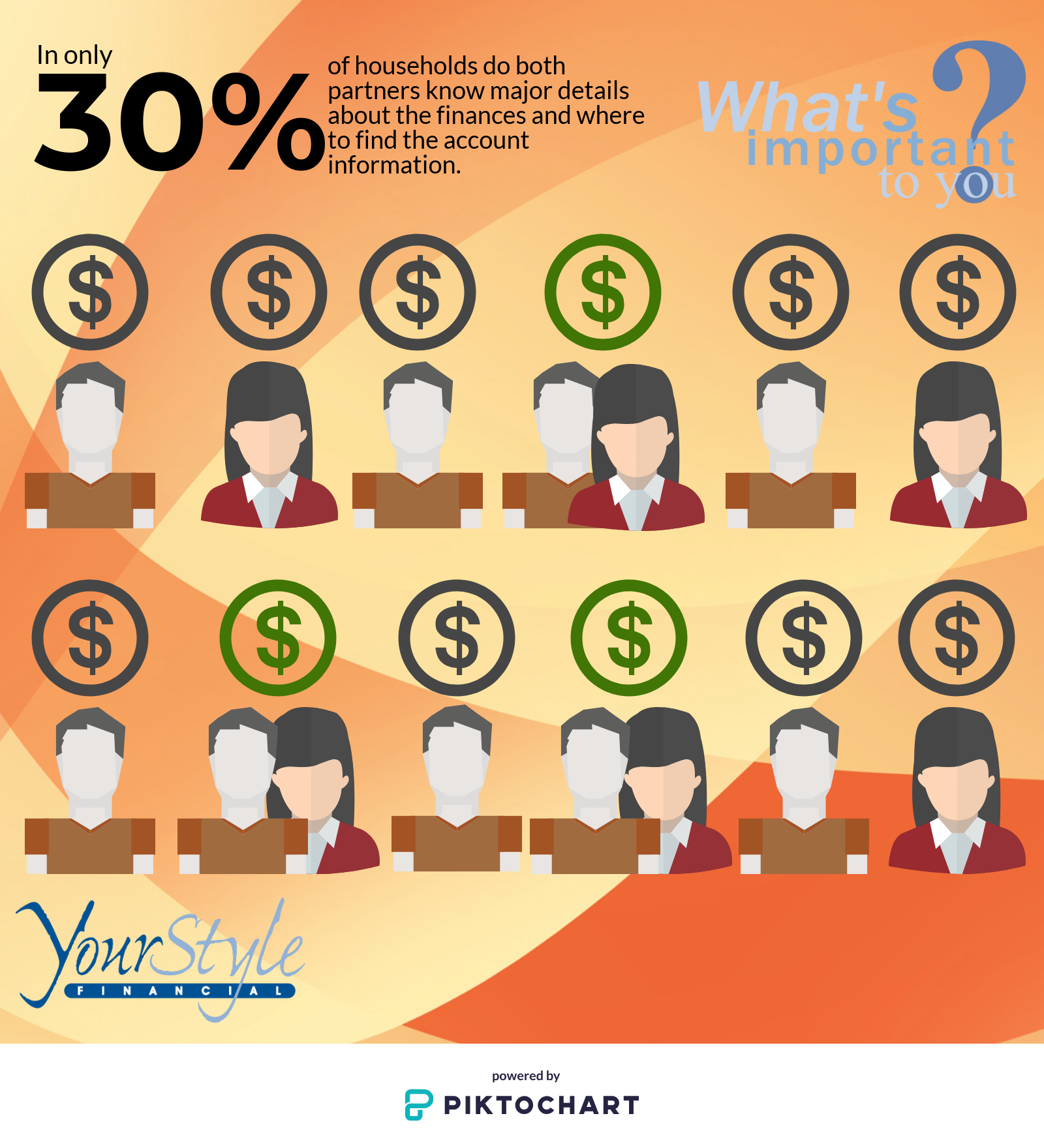
You’ve found “the one” and have decided you will spend the rest of your lives together. You may have talked about growing your family, a new house and other plans for the future but have you thought about how you will achieve those goals? Marriage is a partnership and you need to know how you can achieve those goals together. Discussing your finances may not be a conversation that you want to have but it is necessary to avoid issues that may arise later. Debt, for example is one of the most important things a couple should discuss. Do you or your partner have any outstanding debt? If yes, does your partner know about it? Are you aware of each other’s income? Whatever the case may be, you need to communicate with each other and be open about your finances. A recent BMO survey shows that most married Canadians wish they had discussed their financial matters with each other before walking down the aisle. While 98% of Canadians agree they should be on the same page as their spouses, when it comes to finances, most of them aren’t! A whopping 40% of these couples say they have different investing styles from their partners. It’s not surprising then, that more than half of Canadian married couples have financial regrets, with 62% saying they wish they had discussed their financial plans and pasts before getting married. Use our Marriage Preparation Checklist to discuss with your partner to ensure your plans for wedded bliss include financial matters. For help with your financial planning, give us a call.

Back to top